PDF

Envoyer par mail

Lavoir - fontaine - abreuvoir

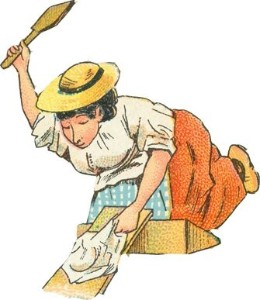
lavandière battant le linge

Il existait un autre lavoir non bâti, qui faisait aussi office d'abreuvoir pour les animaux. Il était situé au bord du Couget, proche de l'intersection de la rue du Vidalet et de la rue du Couget. Lors de la construction du chemin de fer, un passage sera délimité à cet endroit pour les piétons et les bestiaux; il permettait ainsi aux habitantes du hameau des Cigareaux d'aller laver leur linge à ce lavoir, plus proche de leur domicile. Ce passage piétons sur la voie ferrée a été supprimé dans les années 2000.

Lieu de travail:

La lessive était faite 2 à 5 fois par an, aux périodes où il y avait peu de travaux dans les champs; plus tard, la lessive se fit plus fréquemment : vers 1900 une fois par mois, puis vers 1930 une fois par semaine...
La lessive prenait plusieurs jours : un jour pour chaque étape :

  • le trempage
  • le décrassage
  • le coulage
  • le rinçage, essorage, séchage

Le linge à blanchir était mis à tremper à la maison, puis disposé dans une cuve en bois ou en pierre, avec de la cendre (récupérée et tamisée) et parfois des plantes telle la saponaire. Il était ensuite arrosé d'eau chaude que l'on récupérait, que l'on réchauffait et reversait. Cette opération nommée coulage durait une journée. Ce procédé dura jusqu'à l'invention de la lessiveuse au début du XXe siècle.

The Wash House and the Watering Trough

During the 19th century, the unmanaged use of water sources contributed to the spread of diseases such as cholera, smallpox, and typhoid. Therefore the creation of wash houses resulted from a growing collective awareness of hygiene principles. In 1851, the French Parliament passed a law allocating a special 30 percent subsidy for the construction of public wash houses and from then on, the construction of watering troughs, wells, and wash houses proliferated in towns and villages in France.

It was only in 1896 that the municipality of Brax undertook the construction of a wash house and its trough near the La Chauge brook. This brook originates in the Bouconne Forest, runs alongside the castle park, and flows into the Courbet river just

before the main road to Lévignac. The construction of this public washhouse was a response to hygiene requirements and to ease the arduous task of the women who before had washed their laundry directly in the Chauge brook.

It is supplied by several springs, the water from which is captured and stored in two large underground brick tanks. This washhouse and watering trough complex, which served as both a living space and a workspace, fell into disuse in the 1950s and 60s.